

Know when your webhooks break, not when customers report it
Webhook Monitoring
Monitor webhook receipt, payload validation, processing, and downstream actions. Catch broken event flows before they cause silent product failures.
- 03:05:12delivery received
03:07 · the problem
Why Webhook Monitoring Matters
Webhooks are the glue between your product and external services. Payment confirmations, event notifications, third-party integrations: they all depend on webhooks arriving and being processed correctly.
The problem is that webhook failures are invisible. The sender gets a 200 response from your endpoint, but the processing behind it can fail silently: a missing field, a malformed payload, a downstream service that never received the data.
Without monitoring each step, you only find out when a customer asks why their payment was never confirmed or their integration stopped working.
03:08 · where it breaks
What Can Go Wrong with Webhooks
Payload arrives but validation fails silently
Your endpoint returns 200 but the data inside is missing required fields or has unexpected types.
Processing stalls without an error
The webhook is received but the worker that processes it hangs, times out, or never picks it up.
Downstream action never fires
The webhook was processed but the next step (sending a notification, updating a record, triggering a sync) did not happen.
Retries mask the real problem
The sender retries and eventually succeeds, but the original failure and its side effects go unnoticed.
07:30 · how Uptimy fixes it
Example: Stripe Payment Webhook
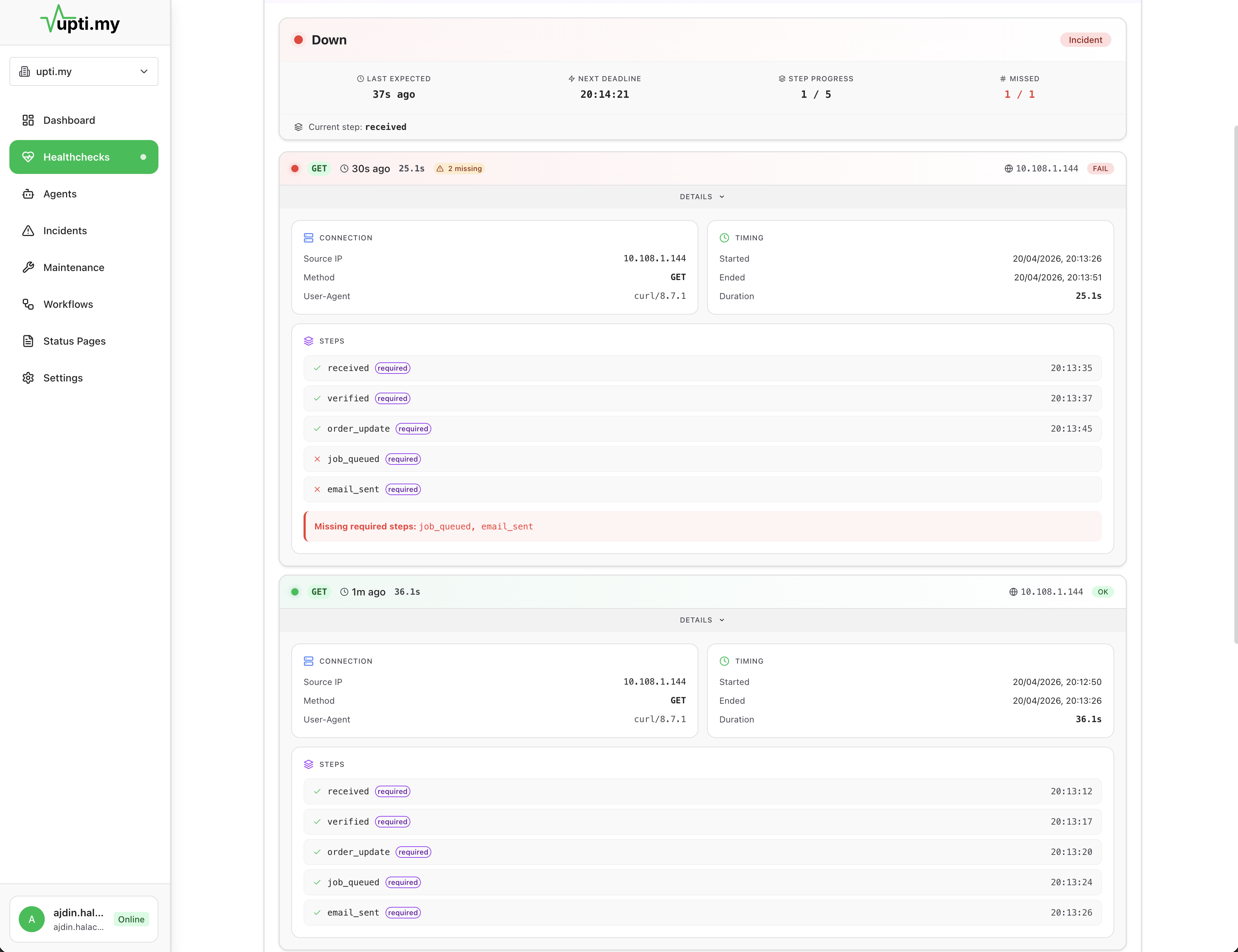
Stripe sends a payment_intent.succeeded webhook to your app. Here is what happens next, and where it can break:
Queue write succeeds but order_id is null because the payload mapping changed after a Stripe API version bump
Without webhook monitoring: The endpoint returned 200. Stripe marks the webhook as delivered. No error appears in your logs. But the fulfillment job processes with a null order, and the customer never gets their product.
With Uptimy: Step 4 reports that order_id failed validation. Alert fires immediately. You fix the payload mapping before more orders are affected.
13:00 · fits your stack
How Uptimy Monitors Webhooks
If any step does not check in, checks in late, or reports invalid data, you get alerted with the exact step that failed and the context around it.
What You Can Track
Works with Any Webhook Source
17:00 · questions
Frequently Asked Questions
Webhook monitoring tracks the full lifecycle: whether the webhook was received, whether the payload passed validation, whether processing completed, and whether downstream actions fired correctly. It goes beyond checking if a URL is reachable.
You define expected fields and validation rules for each webhook step. When a payload arrives with missing or malformed data, Uptimy flags it as a validation failure even if the HTTP request itself returned 200.
Yes. You instrument the processing side of the webhook. When your system receives and processes a webhook from any provider, each step reports to Uptimy so you can track the full flow.
Uptimy alerts you when any step in the webhook processing pipeline does not check in, checks in late, or reports invalid data. You get visibility into which step broke and what data was involved.
Endpoint monitoring tells you the URL is reachable. Webhook monitoring tells you the event was received, the payload was valid, the processing completed, and the downstream action succeeded. Most failures happen after the endpoint responds 200.
20:00 · keep exploring
Related Topics
23:00 · goodnight
Stop wondering if production is okay.
Tonight, if something breaks, you will know first — with the context to fix it and a status page that keeps customers informed. And if nothing breaks, you get to sleep.
Free plan available · No credit card required · Cancel anytime