

Everything you can monitor with Uptimy
Monitoring Capabilities
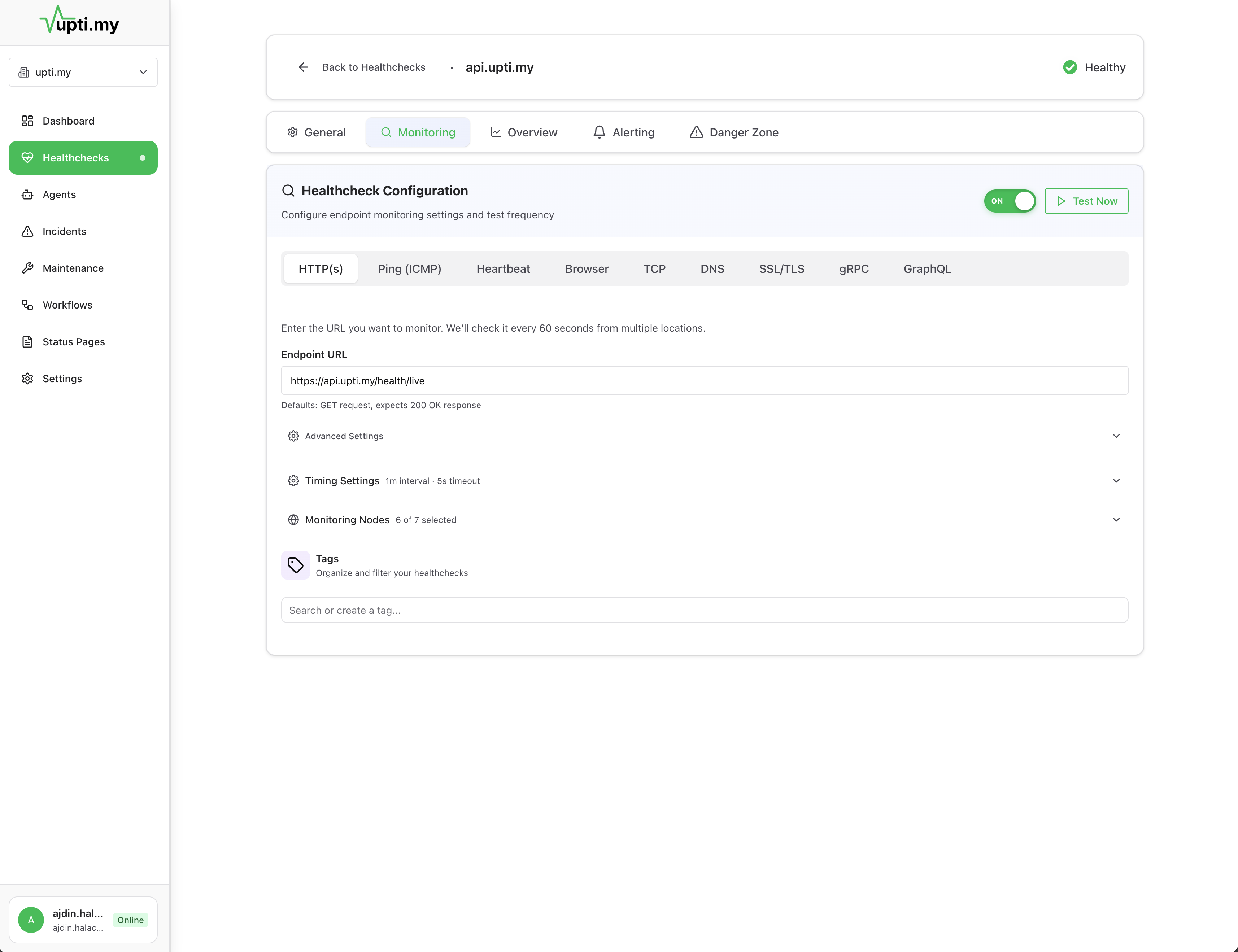
Most monitoring tools stop at "is the site up." Uptimy goes deeper: APIs, background jobs, webhooks, multi-step workflows, certificates, DNS, browser flows, incidents, and customer-facing status pages. One platform covers the full stack.
- 03:06:00website · 200 OK · 142 ms
03:07 · the problem
Overview
This page is the full capability map. Every monitor type feeds into the same incident, alerting, status page, and automation pipeline.
03:08 · where it breaks
Endpoint, API, DNS, and Certificate Monitoring
Endpoint and API Monitoring
07:30 · how Uptimy fixes it
Background Jobs and Synthetic Monitoring
Background Job Monitoring
Catch failures inside cron jobs, webhooks, and multi-step workflows, not just whether a process started.
13:00 · fits your stack
Incidents, Automation, and Next Steps
Incidents, Status Pages, and Alert Routing
17:00 · questions
Frequently Asked Questions
No. Uptimy handles uptime checks, API monitoring, cron jobs, webhooks, queues, workflows, incidents, status pages, and alert routing in one platform. You do not need to stitch together multiple services.
Yes. Use heartbeat monitoring: internal services and jobs send a simple outbound ping to Uptimy on a schedule, and a missed ping opens an incident. Nothing needs to be exposed to the internet.
Health checks run as frequently as every 15 seconds from multiple global locations. For cron jobs and workflows, detection depends on the expected schedule and step timing you configure.
Slack, Discord, Telegram, email, SMS, Microsoft Teams, PagerDuty, WhatsApp, Linear, GitHub Issues, Railway, custom webhooks, and automatic status page updates. Alert routing workflows let you control who gets notified and when.
Checks run from multiple global locations. A single failed probe does not trigger an alert. Uptimy confirms failures from additional regions before creating an incident, which cuts down on noise significantly.
Yes. External checks run from our global infrastructure. For internal services, heartbeat monitoring works from behind your firewall with outbound-only pings. Both feed into the same dashboards, incidents, and alert routing.
20:00 · keep exploring
Related Topics
Compared to Basic Uptime Monitoring
Why checking if the site is up is not enough for production reliability.
Incident Management
Connect detection to response with incidents tied to monitoring and updates.
One Reliability Stack
Replace multiple vendors with one platform.
Workflow Monitoring
Track multi-step processes and catch the failures that other tools miss.
23:00 · goodnight
Stop wondering if production is okay.
Tonight, if something breaks, you will know first — with the context to fix it and a status page that keeps customers informed. And if nothing breaks, you get to sleep.
Free plan available · No credit card required · Cancel anytime